+IT & Digital Systems

JerichoOng.

From physical infrastructure to digital systems.

13 years in construction project management. Now developing software, data and simulation skills to investigate how digital systems can support physical operations.

Tokyo, Japan
01 / 03Field to systems
A different foundation

CONSTRUCTION × TECHNOLOGY × HUMAN POTENTIAL

PORTFOLIO / 2026

From site constraints
to system requirements.

My starting point is construction project management: coordinating materials, crews, equipment and site information.

A late delivery can disrupt a work package. An unavailable machine can change the sequence. In practice, reliable coordination depends on knowing which conditions are confirmed and which still need review.

I’m developing my software and data skills through IT studies, a construction supply capstone and independent research. I focus on requirements, data quality and workflows that support decisions under real operational constraints.

Jericho OngConstruction experience, applied to systems requirements.
01

Field experience

Understand the operation

02

Systems thinking

Identify dependencies

03

Software & data

Develop and validate

From material flow
to coordinated work.

Construction and logistics share the same constraints. I study how information can connect procurement, delivery and workfront readiness.

CONNECTED OPERATIONS / 01Conceptual systems blueprint
OPERATIONS / SYSTEM STUDY
Construction supply-to-site systems blueprintAxonometric warehouse, delivery vehicle and structural workfront. A solid route shows material movement; dashed links connect proposed stock, delivery and work-package records. Human review sits between information and operational action. Concept drawing, not to scale.Stock record01 / INFORMATION OBJECTDelivery slot02 / INFORMATION OBJECTWork package03 / INFORMATION OBJECTHuman reviewReceiving + allocationWorkfront constraintsAccess / staging / handoffzxyAXONOMETRIC STUDY / NOT TO SCALECONCEPT / DX–01
Physical material flowProposed information linkHuman decision
OPERATIONAL DEPENDENCY01 / 03

Start with the material, not just the order.

A purchase order does not establish that material is ready for use. Stock records, reservations and receiving checks need to describe the same physical supply.

Shared information
Stock on hand · allocations · open orders
Constraint
Availability and receiving status
Decision point
Verify the quantity before releasing an order.

Independent research into requirements, dependencies and information handoffs.

Select a point to inspect
01

Construction DX

I draw on construction project management to frame requirements for inventory, procurement and site reporting. The focus is practical: reliable records, visible dependencies and accountable decisions.

Requirements analysis / operational workflows
02

Logistics DX

My independent research considers delivery scheduling, material flow and information exchange between suppliers and sites. API integration and event-driven coordination are research directions within that work.

Material flow / inter-system coordination
Read the research framework

Applied work.
Independent research.

A closer look at the problems I’m working on, the systems I’m studying and the evidence behind them.

FIELDOPS AI · PLANNED WORKFLOWCONCEPT
FieldOps AI architecture conceptA construction site and materials connect to planned software, data and secure tool integration, then an agentic workflow, human approval and an auditable action record.
  1. Field requirements
  2. Software & data
  3. Secure tools
  4. Agentic workflow
  5. Human approval
  6. Auditable action

Construction and logistics experience informs the proposed workflow. Architecture and workflow design in active development · Private source.

ACTIVE DEVELOPMENT/01

Architecture & Workflow Design

Applied AI / Technical Delivery / FDE-Style Project

FieldOps AI

Bilingual Agentic Workflow for Construction & Logistics

Turning construction and logistics experience into operational requirements, then software and data workflows. FieldOps AI explores secure tool integration, agentic planning, human approval and auditable operational action.

Operational requirementsSecure toolsHuman approvalAudit trail
PRIVATE SOURCE

CASE STUDY IN DEVELOPMENT

Behind the project+

The problem

Field decisions depend on scattered operational context. A useful AI workflow needs clear requirements, controlled access to tools and a record of who approved each action.

The approach

Design a bilingual path from operational requirements through software and data, secure tool integration and agentic workflow to human approval and auditable action. The architecture illustration is a concept; provider adapters and autonomous agents are not presented as working integrations.

Evidence & status

Active development at the architecture and workflow design stage. Source remains private; the public case study is in development. FDE-style describes the project approach, not professional FDE employment. No production deployment or completed system is claimed.

SENTRIVELA · SECURITY ARCHITECTURECONCEPT
Sentrivela cybersecurity architecture illustrationA shield stands within a drawn security boundary, connected to a system schematic and a review document. This conceptual illustration contains no live security data.
  1. System context
  2. Security boundary
  3. Human review

A conceptual cybersecurity architecture illustration for Sentrivela: systems, security boundaries and human review.

PROTOTYPE/02

Early security-monitoring prototype

Cybersecurity / Security architecture

Sentrivela

A personal cybersecurity architecture project exploring security protocols and their practical application. Its early prototype explores mobile-friendly security monitoring, alerts and incident management.

PHPJavaScriptHTML / CSSSecurity architecture
PRIVATE SOURCE

Public demo not yet available

Behind the project+

The problem

Explore how security information and alerts can be made accessible for review from a mobile-friendly interface.

The approach

An early web prototype using PHP, JavaScript, HTML and CSS, with simulated alert handling. AI-assisted monitoring and incident management remain intended capabilities, not verified working features.

Evidence & status

The source README identifies work in progress. Read-only source review confirms an early prototype, and repository visibility is verified private. No public demo, production monitoring or completed system is claimed.

FROM THE FIELD TO A DECISIONILLUSTRATIVE
Site study / delivery · materials · work areas
  1. Delivery
  2. Site readiness
  3. Human decision

One delayed delivery. A site full of connected decisions.

Independent research/03
Domain research / Systems architecture

Construction & Logistics DX Japan

Connecting the construction site to the supply chain. A bilingual framework for material flow, site operations and digital coordination.

Construction DXLogisticsDigital twins
Behind the project+

The problem

Materials, people and equipment are often planned in separate systems. The handoffs between them create operational friction.

The approach

Document construction sites as logistics nodes; explore JIT delivery, API coordination, IoT and digital-twin concepts.

Evidence & status

Public bilingual documentation. Conceptual architecture, not a deployed commercial system.

Explore the site decision exerciseExplore the research
CONTEXT → SUGGESTION → REVIEWILLUSTRATIVE
  1. Observed context
  2. Proposed action
  3. Human review

A workspace cue becomes a suggestion. A person decides.

Research framework/04
Physical AI / Human–system interaction

Embodied Anticipatory Personal Assistant

What if an assistant could understand the next useful action? A research architecture for perception, prediction and human-guided action.

Embodied AIWorld modelsHuman oversight
Behind the project+

The problem

Reactive assistants wait for a command. Real physical assistance also needs context, anticipation and safe interaction.

The approach

A perception–prediction–action loop with multimodal context, a predictive world model and explicit human oversight.

Evidence & status

Public architecture and implementation guidelines. No claim of a working robot or production deployment.

Read the architecture
MATERIAL → RECORD → REQUESTILLUSTRATIVE
  1. Physical materials
  2. Stock record
  3. Order request

Connect what is on the shelf with what is needed next.

Academic project/05
Academic project / Web systems

Construction Supply Inventory & Ordering

A capstone connecting construction experience with IT: a web-based inventory and ordering system for construction supply businesses.

InventoryOrderingWeb systems
Behind the project+

The problem

Construction supply operations need a clearer connection between stock availability and customer orders.

The approach

The documented capstone focuses on a web-based inventory and ordering workflow for construction supply businesses.

Evidence & status

Listed in the public profile. A public repository, demo and completion status are not yet verified.
View project context
Currently building

Developing software and systems capability.

FieldOps AI connects my construction and logistics experience to applied AI architecture and workflow design. Sentrivela continues my cybersecurity work alongside IT studies, the construction supply capstone and independent DX documentation. SITEARM and the Omniverse learning pathway define the next research direction.

~13 yearsConstruction project managementPhilippines · site operations
Field → ITA connected perspectiveCareer transition
BS ITETEEAP studiesUndergraduate studies in progress
IndependentConstruction & Logistics DXTechnical research & documentation

Field experience.
Technical development.

My transition into IT builds on construction project management. Formal study, practical development and continuing education are ongoing parts of that work.

Tokyo, Japan
02 / 03An evolving perspective
THE FOUNDATIONExperience

Construction project management.

13 years in construction project management in the Philippines — coordinating materials, people, equipment and the realities of site operations.

Construction operations · Project coordination
THE TRANSITIONIn progress

From site operations to information systems.

A civil-engineering academic foundation now meets ongoing BS Information Technology studies through the University of the East’s ETEEAP program.

IT studies · Construction supply capstone
THE PRESENTIndependent research

Construction & Logistics DX research.

Based in Japan, documenting Construction & Logistics DX concepts and exploring how data, automation and intelligent systems can support physical operations.

Bilingual documentation · Systems thinking
CONTINUING DEVELOPMENTOngoing learning

Management, IT & professional Japanese.

Continuing PMI learning in project management and generative AI, preparing for IPA examinations, and developing business Japanese toward BJT goals.

PMI learning · IPA preparation · BJT study
THE DIRECTIONLong-term goal

Toward systems architecture.

Build software, data and security foundations, then extend the research toward OpenUSD scene composition, NVIDIA Omniverse workflows and simulation for construction robotics.

Systems architecture · Omniverse / OpenUSD · SITEARM

Tools for
the work.

PHP and MySQL anchor my systems work. My wider toolkit covers frontend development, data analysis, technical documentation and AI-assisted development, with further study in cloud and simulation.

Core systems stack

Core PHP systems

PHP application logic, MySQL data storage and SQL queries form the core of my systems toolkit.

  • PHP
  • MySQL
  • SQL
Portfolio stack · installed versions

Frontend & interaction

Semantic HTML follows the HTML Living Standard. Modern CSS uses Grid, Flexbox and custom properties for responsive layouts; JavaScript uses ES modules.

  • Semantic HTML
  • Modern CSS
  • JavaScript (ES modules)
  • Next.js 16
  • React 19
  • TypeScript 6
  • Tailwind CSS 4
  • Motion 13
  • Lenis 1.3
Practice & continued study

Programming & development environment

Scripting, command-line work and software fundamentals.

  • Python
  • Node.js
  • Linux
  • Bash
  • PowerShell
  • Visual Studio Code
Local development & administration

Local PHP development

XAMPP for a local PHP development environment and phpMyAdmin for database administration.

  • XAMPP
  • phpMyAdmin
Data tools & continuing study

Data, interchange & business intelligence

JSON for data interchange and Power BI for reporting and visualization, alongside continued study of PostgreSQL and AWS foundations.

  • JSON
  • Microsoft Power BI
  • PostgreSQL
  • AWS foundations
Documentation workflow

Version control & technical documentation

Requirements, research notes and a traceable history of changes.

  • Git
  • GitHub
  • Markdown
  • Notion

AI in my workflow

These tools support research, coding and technical writing across overlapping workflows. Google AI Studio also supports application prototyping. I review outputs against requirements, source material and tests.

Research & technical writing

  • ChatGPT
  • Claude
  • Gemini
  • Google AI Studio

Coding & prototyping

  • Codex
  • Claude Code
  • Cursor
  • Replit
  • Google Antigravity
  • Google AI Studio

Notion supports research notes and planning; Markdown and GitHub keep technical documentation alongside the work.

  1. Define requirements
  2. Draft & implement
  3. Review assumptions
  4. Test & document
Research & learning

Event, spatial & integration systems

Technologies I am studying for construction and logistics architectures: event streams, spatial queries, shared state and service interfaces.

  • Apache Kafka
  • PostGIS
  • Redis
  • REST APIs
Learning pathway

NVIDIA Omniverse / OpenUSD

My planned progression from scene description to simulation, with construction and logistics as the application domain.

  1. 01Learning direction

    OpenUSD foundations

    Scene structure, coordinate systems, transforms and reusable assets.

  2. 02Planned study

    Scene composition

    Combine construction and logistics assets with consistent scale and documented assumptions.

  3. 03Research direction

    Robotics simulation

    Evaluate simulation workflows for SITEARM, including reach, collisions and the gap between models and field conditions.

PMI learning, IPA preparation & business JapaneseIcon credits

Operational constraints.
A decision to review.

Explore three construction coordination cases: a delivery delay, an inventory discrepancy and unavailable equipment. Review the dependencies and compare the consequences of each response.

SITE STUDY / 01Illustrative decision exercise
FIELD VIEW2.5D / CONCEPT MODEL
Site study / delivery · materials · work areas
InformationNeeds confirmationIllustrated response
CASE REVIEW01 / 04
Observe

A critical material delivery has no confirmed arrival time.

A crew and lifting equipment are booked for the dependent task.

Start with what is known.
DECISION REVIEW

Select an operational response.

Choose a response, consider its conditions, then confirm. The scene will show the possible consequence.

Your choice stays in this exercise.
BEFORE CONFIRMING

The site lead checks prerequisites, safety and crew availability before approving a change.

A proposal becomes an illustrated response only after you confirm.

Inspect the systemSource · review · data contract
BEHIND THE SCENE

A decision needs context.

This local, rule-based example connects a signal, its uncertainty, a proposed response and a human review state. It uses illustrative scenarios without sensors, personal data or a live AI connection.

Confirming a choice illustrates an outcome. It does not verify operational prerequisites or authorize work on a real site.

EXAMPLE DATA CONTRACT / NO LIVE DATA
{
  "scenario": "delivery",
  "stage": "observe",
  "source": "illustrative_no_live_data",
  "proposed_response": null,
  "human_review": "pending",
  "illustrated_response": null,
  "operational_prerequisites": "not_verified_by_this_exercise",
  "privacy_boundary": "no_personal_or_sensor_data"
}
Independent research / wearable roboticsConcept stage · simulation-first research

SITEARM

Human-centered wearable robotic assistance research for construction and logistics

Let the task define the assistance.

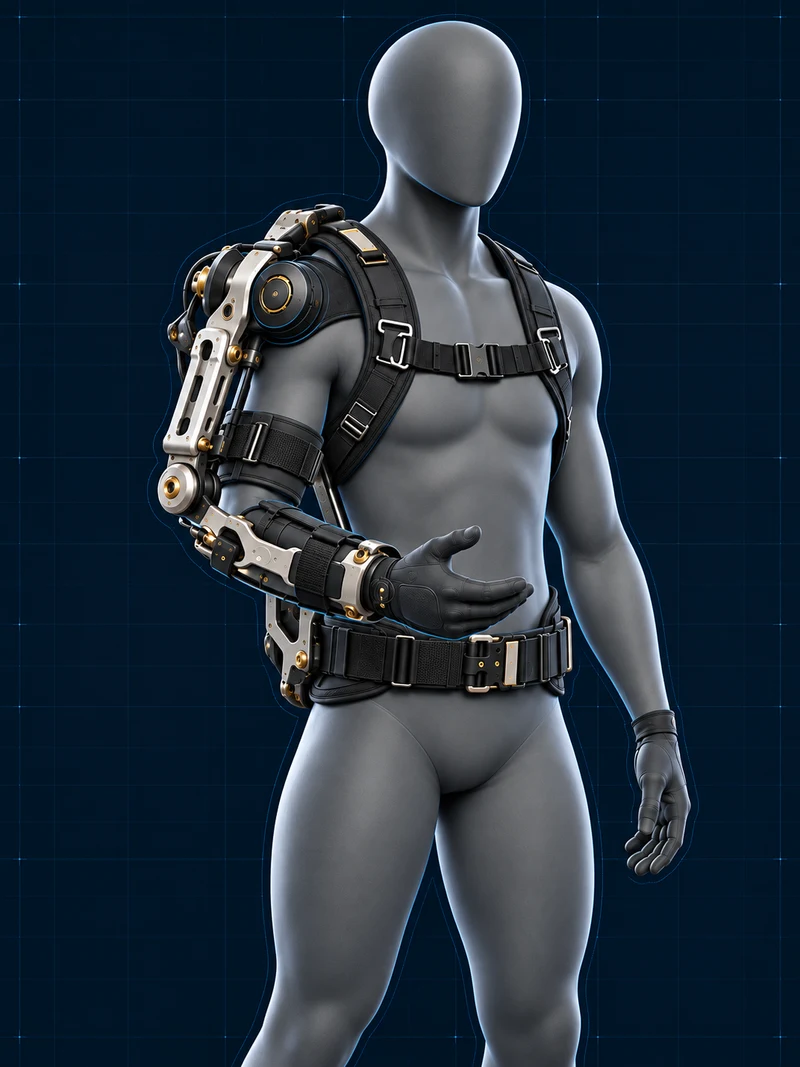
SITEARM explores how wearable robotic assistance could support lifting, positioning and material handling. The research begins with the worker, task, load, movement and operating environment, then investigates a body-worn upper-limb mechanism around those requirements.

Explore the conceptsResearch stack
Simulation-first research plan
Clarified SITEARM visual-intent illustration: a human mannequin wearing an upper-limb mechanism, with padded cuffs and a proposed torso connection. Not a CAD export.
SITEARM / VISUAL INTENTHUMAN + WEARABLE MECHANISM
AI-assisted illustration · not a CAD export. Inspect the separate geometry studies below.
THE RESEARCH BOUNDARY

A wearable upper-limb robotic system. Human control is a design requirement. These are design investigations—not manufactured products or validated assistance systems.

01 / The working context

Physical work is a human-system problem.

Repetitive lifting, elevated arms and constrained working positions shape construction and logistics tasks. These environments also demand perception, dexterity and judgment. SITEARM asks where wearable support could fit within that work.

The human–device system

The person is part of the mechanism.

The proposed system couples a wearable linkage to the upper body. Human motion, joint alignment, attachment interfaces and load interaction must be considered together. Kinematics, biomechanics, ergonomics and human–robot interaction frame the investigation.

02 / Design investigations

Three ways to study assistance.

Distinct task requirements. Different mechanical questions. Each concept is a proposed direction for study.

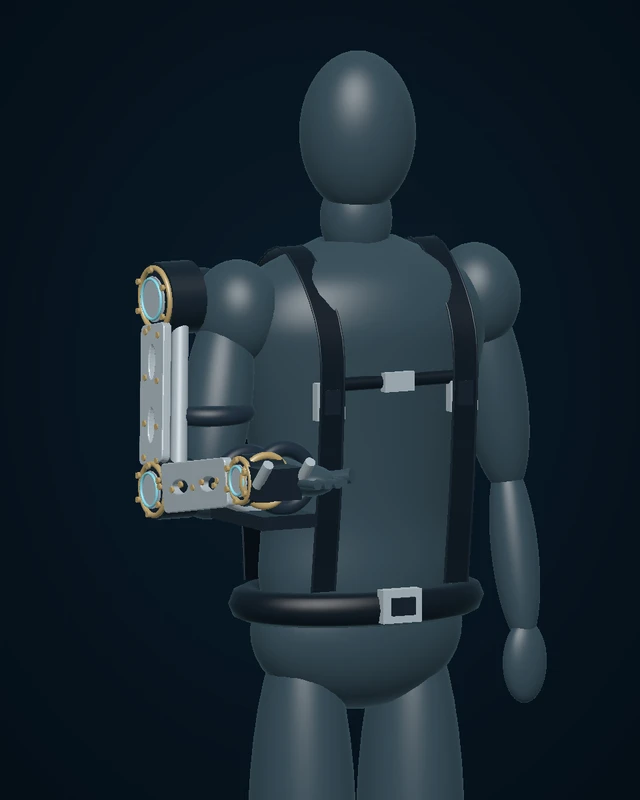
SA-03 / GEOMETRY INSPECTIONONE ASSEMBLY · FOUR VIEWS
M1 / Three-quarterUNITLESS CONCEPT GEOMETRY
SITEARM M1 / Three-quarter / shared concept geometry, not a validated device

One authored assembly per concept. View controls change the camera, not the mechanism.

Inspect the proposed interfaces

Visible attachment interfaces express modularity. Each configuration would need separate alignment and load evaluation.

DESIGN STATUS
Geometry
Proposed / unitless
Actuation & materials
Not selected
Joint alignment & fit
Not evaluated
Assistance & safety
Not validated

Authored concept geometry · not to scale · no performance data

The four views and optional 3D inspection share one model per concept. Camera motion is not a kinematic simulation. Geometry, body fit and structural connections are proposed; materials, actuation and performance are not specified or validated.

SA-03 / DESIGN INVESTIGATION

SITEARM M1

Modular Task-Assist Arm

A proposed modular wearable architecture for changing between lifting, holding and guiding tasks.

Task context
Mixed construction and logistics workflows with different assistance needs.
Proposed architecture
A common body interface would accept task-specific support modules. Module geometry, attachment constraints and assistance behavior would be evaluated as a coupled configuration.
Potential benefit to investigate
Potential to adapt the assistance to the work without redesigning every body interface. Useful task coverage remains a research hypothesis.
Design limitations
Modularity adds mass, interface complexity and configuration-dependent behavior. Each combination would need its own evaluation.
THE MECHANICAL QUESTION

Can a common body interface support different task modules without compromising alignment, movement or structural load transfer?

Planned evaluation priorities
  • Module-interface constraints
  • Configuration-dependent behavior
  • Comparative task coverage
Modular Task-Assist Arm
03 / Research method

Begin with the person and the task.

A proposed sequence for making the design assumptions explicit before evaluating an assistance concept.

  1. 01

    Task

    Describe motion, object or tool, external load, duration, repetition, access and operating conditions.

  2. 02

    Human model

    Represent arm geometry, joint motion and the assumed range of body dimensions.

  3. 03

    Wearable model

    Define candidate links, human-device interfaces, joint locations, structural connections and alignment requirements.

  4. 04

    Kinematics

    Examine relative motion, joint limits and compatibility with human movement.

  5. 05

    Workspace

    Compare reachable poses with task access and clearance constraints.

  6. 06

    Simulation

    Evaluate selected scenarios using explicit models, assumptions, boundary conditions and evaluation criteria.

  7. 07

    Results

    Record supported findings, uncertainty, untested conditions and the need for physical validation.

Explore the technical scope

Kinematics

Human and wearable joint motion, relative transforms, alignment and reachable configurations.

Biomechanics

Proposed load paths, body–device interaction and the assumptions needed to interpret mechanical support.

Ergonomics

Fit, posture, contact interfaces, donning and freedom of movement as design considerations.

Human–robot interaction

User control, intention, predictable assistance and the ability to adjust or disengage support.

Task-driven design

Compare configurations against a defined task and assess suitability for each intended activity.

Simulation-first evaluation

Use models to test selected design questions before deciding whether a physical study is justified.

Reality Gap Ledger

Track assumptions about friction, compliance, fit, sensing and site conditions that may alter real behavior.

Concept validation

State the evidence needed for each design claim and distinguish a feasible model from a validated device.

04 / Research toolchain

Numerical foundations. A staged simulation path.

A selected research toolchain—not a claim of completed implementation. The first scope is numerical modeling and reproducible experiments, independent of the portfolio's browser viewer.

  1. 01Python
  2. 02Kinematics
  3. 03Blender
  4. 04Isaac Sim / Omniverse
  5. 05Future Physical AI
01 / Initial scopeSelected · implementation planned

Python + numerical foundations

Python 3.12+ for custom forward and inverse kinematics, explicit joint limits, workspace sampling and coupled human-arm / wearable-link geometry. Begin with defined test cases, not a robotics middleware stack.

Math & visualization
NumPySciPySymPyMatplotlib
Inputs → outputs
YAMLJSONCSV
Tests & quality
pytestRuff
Documentation & history
MarkdownMermaidGitGitHub
02 / NextPlanned

Geometry with traceable assumptions

Use Blender for detailed concept assemblies and consistent camera views. Add PyVista when numerical 3D inspection is useful, and mypy as the Python interfaces stabilize. Blender geometry alone does not establish physical validity.

Modeling & inspection
BlenderPyVistamypy
03 / Advanced simulationLong-term · not a dependency

NVIDIA Isaac Sim / Omniverse

Evaluate Isaac Sim, built on NVIDIA Omniverse libraries, for articulated-body physics, contact and sensor scenarios. Progress depends on model quality, explicit boundary conditions and reproducible baseline tests—not visual fidelity alone.

Planned platform
NVIDIA Isaac SimNVIDIA OmniverseOpenUSD
04 / Optional researchExploratory · outside initial scope

Physical AI, only with a research case

Isaac Lab would be considered only for a later question involving robot learning, reinforcement learning or learned control. No AI/ML model or controller is part of the initial SITEARM scope.

Conditional future direction
NVIDIA Isaac LabPhysical AI
SCOPE CONTROL

Outside the initial research scope: ROS 2, Gazebo, AI/ML, databases, Arduino and hardware control. No physical device is connected to this website.

Presentation is separate from research. This portfolio uses Next.js, React, TypeScript and an optional Three.js concept viewer. A future research-results interface may use the same web stack; React Three Fiber is an option, not a current dependency.

05 / Evidence & design philosophy

A concept should carry its assumptions.

The hero illustration expresses visual intent. The separate 3D studies use consistent, authored concept geometry—not calibrated anatomy, verified CAD or solver results. No physical prototype, measured assistance or ergonomic outcome is presented. The Reality Gap Ledger and Design Passport are SITEARM documentation concepts, not external standards.

01

Reality Gap Ledger

A planned record of assumptions, uncertainties and validation needs. Every finding should retain the conditions under which it was obtained.

02

Design Passport

A planned summary of the wearable configuration, intended task, evaluation scope and limitations, linked to selected supporting evidence when available.

Public research & development boundaries

Selected public documentation

The public portfolio is intended to present selected concept studies, research questions, evaluation summaries and limitations. The level of detail would be chosen for each release.

Future development material

Detailed models, implementation methods and experimental material may remain private during future development. This publication policy applies to work as it develops; no completed internal system is implied.

06 / Future research

A planned path to evaluation.

All phases planned
  1. 01

    Foundation

    • Research questions and task definitions
    • Human assumptions and concept architecture
  2. 02

    Geometry

    • Human upper-limb and wearable links
    • Interfaces and candidate configurations
  3. 03

    Kinematics

    • Forward kinematics and joint constraints
    • Reach, workspace and alignment
  4. 04

    Task evaluation

    • Task scenarios, clearance and loads
    • Configuration comparison
  5. 05

    Assistance modeling

    • Proposed load paths and actuation
    • Force / torque models where justified
  6. 06

    Simulation

    • Scenario and sensitivity analysis
    • Uncertainty and failure cases
  7. 07

    Evidence

    • Reality Gap Ledgers and Design Passports
    • Reproducible experiments and documented results
  8. 08

    Physical validation

    • Future / optional — not started
    • Benchtop and human-device interface studies

An independent research initiative exploring how wearable robotic assistance can be shaped by real-world work.

For employers, researchers and potential collaborators interested in the research direction.

Discuss the research

Current studies.
Next milestones.

Current coursework, examination preparation and proposed research. Each has a different stage of progress.

01

Now

LEARNING & BUILDING
  • IT studies & construction supply capstone
  • Python, data & cybersecurity foundations
  • Construction & Logistics DX research
  • PMI learning: project management & generative AI
02

Next

PLANNED / PREPARING
  • IPA FE: Fundamental Information Technology Engineer Examination preparation
  • IPA SG: Information Security Management Examination preparation
  • IPA AP: Applied Information Technology Engineer Examination, a longer-term goal
  • BJT Business Japanese Proficiency Test: working toward J2 / J1 target levels
03

Exploring

RESEARCH INTERESTS
  • NVIDIA Omniverse / OpenUSD: scene composition and simulation workflows
  • SITEARM: planned research into task-driven wearable robotic assistance
  • Physical AI and cyber-physical systems with human oversight

Examinations and language goals shown here are plans, not earned qualifications.

Technical documentation & independent research.

Research & documentation on GitHub

Better systems.
Built together.

I welcome conversations about construction technology, software and data systems, and simulation research. I’m continuing to develop my technical skills and looking for opportunities to contribute.

Based in Japan. An international perspective.
Tokyo, Japan
03 / 03Open to collaboration